Introduction
zigduck is a NixOS flake that brings version control to your smart home. It’s a full-stack Zigbee home automation system configured entirely through NixOS options, so your house is reproducible and deployable like any other part of your system.
Nix handles configuration and a Rust service handles the runtime. Under the hood it uses
zigbee2mqtt, Mosquitto, tokio and
serde_json, and adb for Android TVs.
Smart defaults
Section titled “Smart defaults”Once you’ve defined your rooms and devices, most homes don’t need any automations at all. Lights, dimmers and motion sensors work as expected out of the box: a dimmer controls the lights in its own room and a motion sensor turns on its room’s lights, unless you override it.
Everything is configurable through NixOS options. See the option reference for the full list.
How it fits together
Section titled “How it fits together” Nix │ ▼ zigduck │ ┌──────┴──────┐ ▼ ▼ MQTT REST API │ │ ▼ ▼ zigbee2mqtt adb/media │ │ └──────┬──────┘ ▼ DevicesYour Nix configuration generates the zigbee2mqtt and Mosquitto setup, the device, room and scene definitions, and the automation rules. The zigduck service subscribes to MQTT and acts on device events, and serves a REST API that the dashboard, the GNOME extension and the CLI all use.
What’s included
Section titled “What’s included”| Component | What it does |
|---|---|
| zigduck service | The Rust runtime that runs automations, tracks device state and serves the API. |
| zigduck-cli | Control devices, scenes, timers, alarms and snapshots from the terminal. |
| Web dashboard | An optional dashboard generated from your config, with custom status cards and pages. |
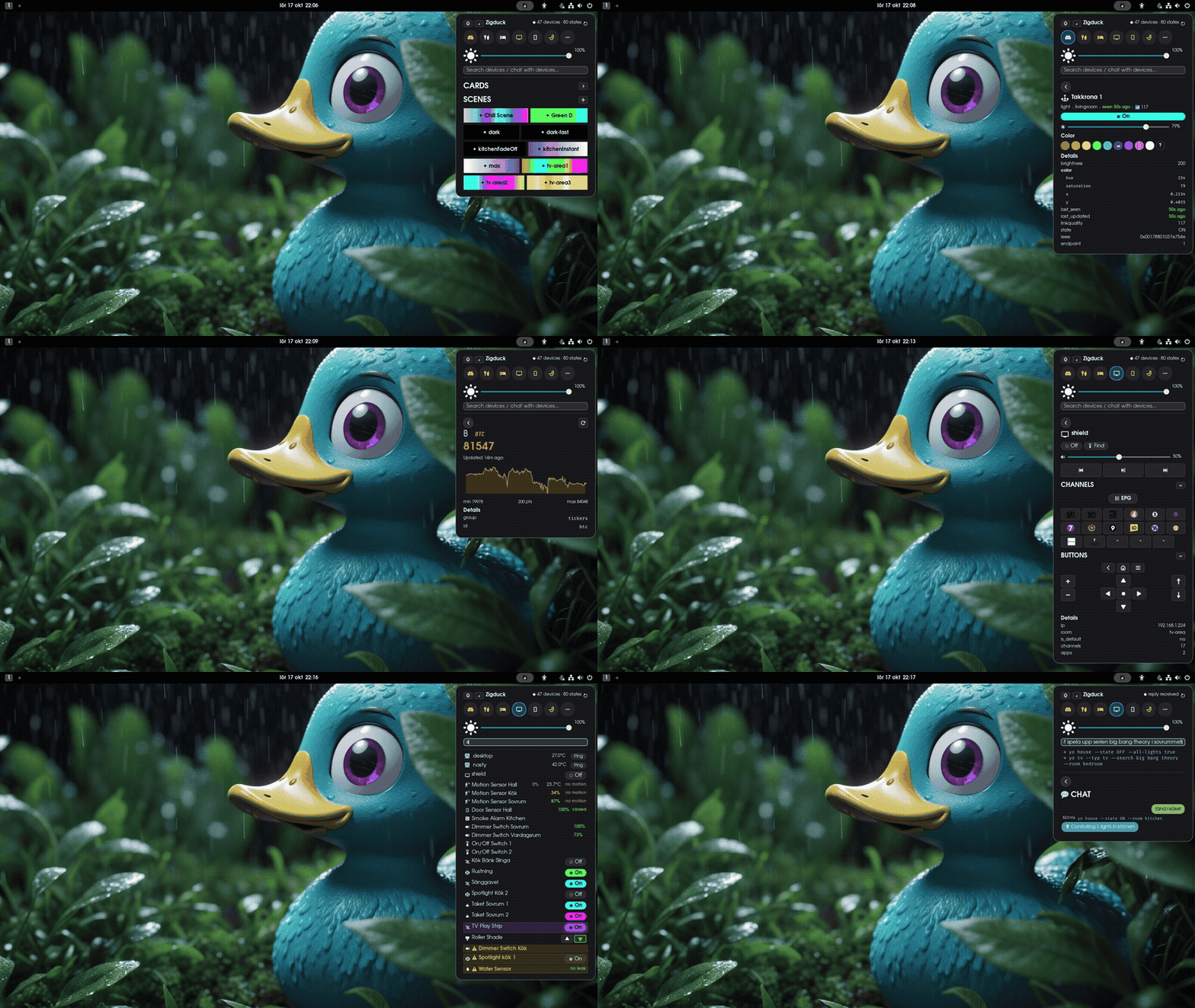
| GNOME extension | A top bar widget for rooms, devices, scenes and the TV guide. |
| tv | Casts media and live TV to Android TVs over ADB, with fuzzy search. |
| tv-scraper | Builds an electronic program guide (EPG) from your channel config. |
| Voice | Natural language and voice control through the companion flake yo. |
Real-world example
Section titled “Real-world example”For a complete configuration running in a real house, see the author’s myHouse.nix.